
Adult Palatal Expansion
The upper jaw can be widened — structurally, skeletally, permanently — without surgery, and without the wide gap between the front teeth that keeps most patients from ever starting
Your Jaw Can Still Be Widened.
A narrow upper jaw can develop for several reasons, including genetics, childhood oral habits, and patterns of facial growth. Previous orthodontic treatment, particularly treatment involving premolar extractions, may also influence dental arch form and the appearance of the smile.
A narrow maxilla can affect more than dental alignment. It may contribute to a smile with prominent buccal corridors (dark spaces at the corners of the smile), reduced support through the midface, limited space for the tongue, difficulty breathing through the nose, and snoring.
In appropriately selected adults, maxillary skeletal expansion can increase the width of the upper jaw. Unlike conventional tooth-supported expansion, skeletal expansion is designed to widen the maxillary bone rather than simply move the teeth.
What Is Adult Palatal Expansion?
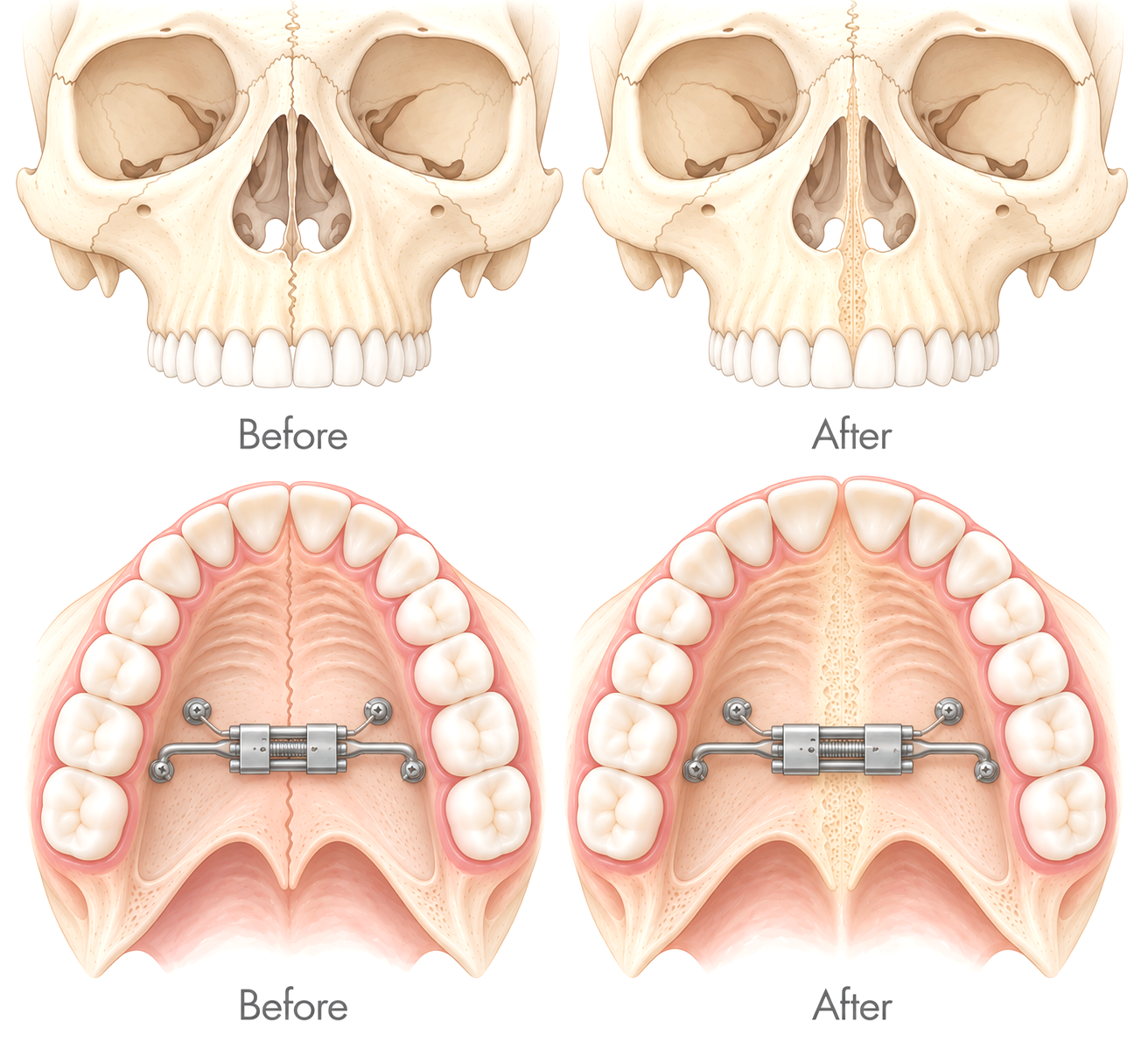
The upper jaw, or maxilla, consists of two halves joined by a seam of bone called the midpalatal suture. During childhood, this suture is relatively flexible, allowing the palate to be widened with conventional orthodontic expanders. As we mature, the suture becomes increasingly resistant to separation, making expansion more complex in adults.
Maxillary skeletal expansion uses specialized appliances anchored to the bone, rather than relying solely on the teeth, to widen the upper jaw. In some adults, additional surgical assistance may be needed to allow the two halves of the maxilla to separate.
The goal is to achieve true skeletal widening, creating more space within the upper dental arch and potentially increasing the width of the nasal passages. This differs from conventional dental expansion, which primarily moves or tips the teeth outward without substantially changing the underlying jawbone.
What Expansion Changes
THE SMILE
A wider arch eliminates the dark triangles at the corners of a narrow smile, called buccal corridors. Teeth fill the mouth when you smile. Crowded or rotated teeth that lacked arch space gain room to align.
THE MIDFACE
The upper jaw is the structural foundation of the midface. Widening it expands the bones that form the cheeks and define lateral facial width. The lateral expansion also widens the orbital rim, improving undereye support and the appearance of the infraorbital region.
This is a structural change. It cannot be achieved with filler, threads, or any surface treatment.
BREATHING AND THE AIRWAY
The floor of the nasal cavity sits directly above the palate. Expanding the palate increases nasal cavity volume, reduces nasal resistance, and creates space for the tongue to rest in a functional position. For patients with sleep-disordered breathing or a history of airway restriction, expansion treats the structural basis of those conditions, not just the symptoms.
The aesthetic and airway outcomes are products of the same procedure. Patients who come for a wider smile often leave breathing differently.
Who Is a Candidate
Adults with a narrow upper jaw may benefit from maxillary skeletal expansion, particularly when the underlying problem involves the width of the jawbone rather than simply the position of the teeth.
Common findings include a narrow smile with dark spaces at the corners, dental crowding, a crossbite, limited space for the tongue, or difficulty breathing through the nose. Some patients also experience snoring or sleep-disordered breathing.
Others have undergone orthodontic treatment earlier in life, including treatment involving premolar extractions, but continue to have a narrow upper arch, limited tongue space, or concerns about their facial proportions.
Three-dimensional CBCT imaging helps assess the skeletal anatomy, degree of maxillary constriction, and suitability for expansion.
The DOME Zero Approach
Precision, control, and predictability in adult skeletal expansion.
Adult skeletal expansion is a complex process. As the upper jaw widens, the teeth move, the dental arches change, and the bite must adapt. The rate and sequence of these changes are just as important as the amount of expansion achieved.
DOME Zero is designed to make this process safer, more controlled, and more predictable. Using a custom expander and synchronized clear aligner therapy, skeletal widening, tooth alignment, and bite correction are planned together from the beginning.
Rather than expanding the jaw first and correcting the resulting dental changes afterward, DOME Zero follows carefully sequenced protocols that coordinate the rate of expansion with tooth movement and bite alignment at every stage. The objective is controlled, progressive skeletal change, not simply the greatest possible amount of expansion.
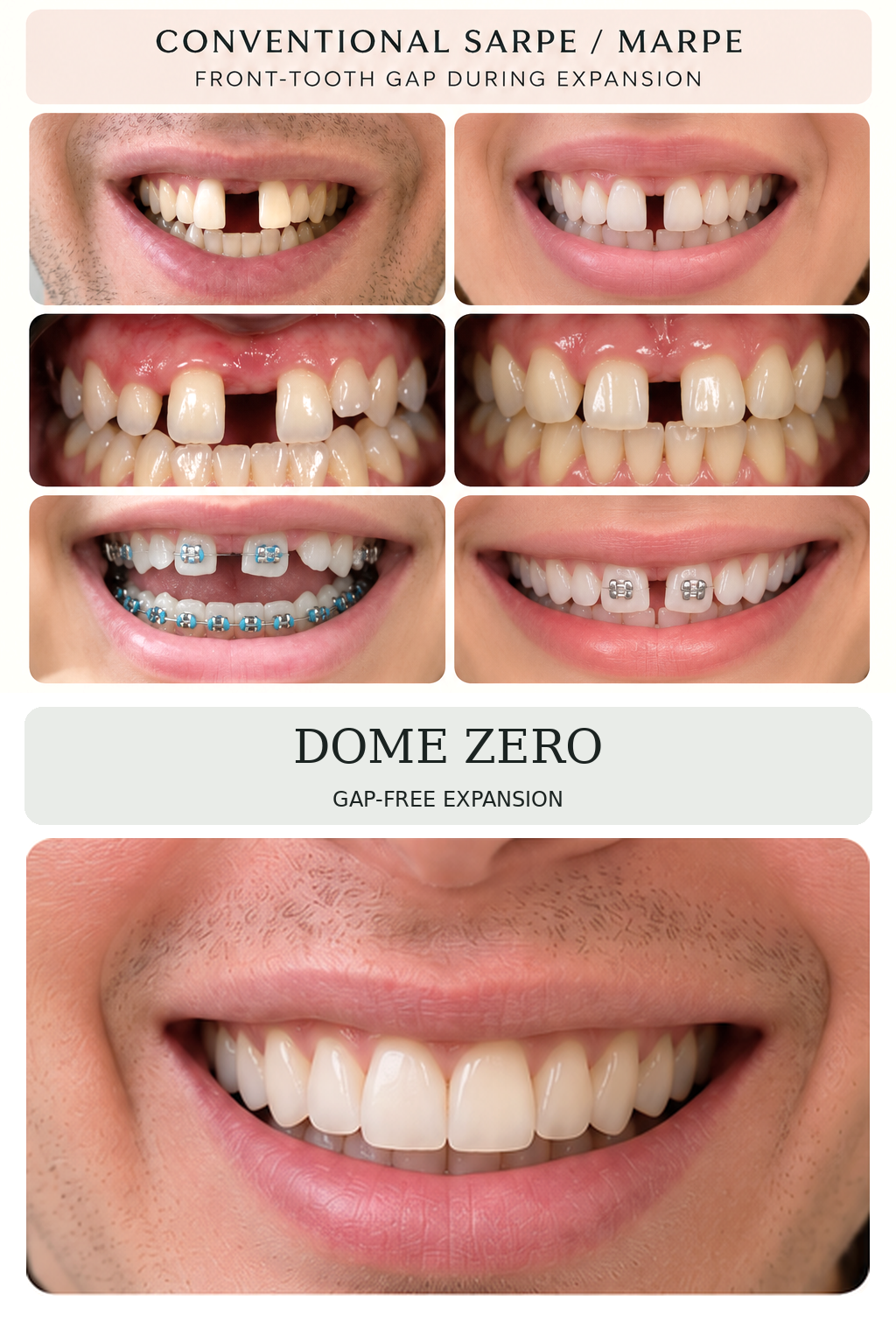
This precision also allows us to prevent the large, visible gap between the upper front teeth, that typically develops during conventional skeletal expansion.
The goal is not just a wider upper jaw, but a stable, functional bite and a carefully managed treatment process in which safety, facial balance, and long-term outcomes guide every decision.
Expansion Without the Front-Tooth Gap
One of the most noticeable aspects of conventional adult skeletal expansion is the large gap, or diastema, that develops between the upper front teeth as the two halves of the maxilla separate.
For many adults, this creates an awkward transitional period—the so-called “ugly phase”—that can last for months while expansion is completed and orthodontic treatment begins to close the gap.
DOME Zero is designed to avoid this phase. By synchronizing clear aligner treatment with skeletal expansion, the front teeth are moved in coordination with the widening jaw, preventing the large, conspicuous gap that would otherwise develop.
Patients can see changes in their smile and facial proportions as expansion progresses, allowing the degree of expansion to be carefully adjusted or stopped as treatment goals are reached. This provides greater control and predictability over both the process and the final aesthetic outcome.
Frequently Asked Questions
-
Yes. For decades it was believed that the midpalatal suture fused in adulthood, making skeletal expansion impossible without surgery. Bone-borne expanders anchored with miniscrews directly to the palate changed this. The miniscrews engage cortical bone and apply force that stimulates the suture to open. The evidence is well established. Adults across a wide age range have been successfully treated.
-
Most patients experience pressure during activation rather than pain. The miniscrew placement procedure is performed under local anaesthesia. Some patients experience mild headache or sinus pressure in the early weeks of expansion. The DOME Zero protocol, using slower expansion forces, typically produces fewer and milder symptoms than rapid expansion protocols.
-
The expansion phase typically takes three to six months depending on the amount of expansion required and the protocol used. With DOME Zero, aligner therapy proceeds concurrently, so overall treatment time is shorter than sequential expansion followed by orthodontics. Total treatment duration varies by case and is discussed in full at consultation.
-
With the DOME Zero protocol, the gap between the front central incisors is managed in real time by aligner therapy as expansion proceeds. For most patients the space remains narrow enough throughout treatment that it does not draw attention. The expander itself sits entirely in the palate and is not visible.
-
Traditional MARPE (Miniscrew-Assisted Rapid Palatal Expansion) uses rapid expansion forces, with orthodontic alignment typically performed after expansion is complete. This often results in a large, visible gap between the upper front teeth that remains until it is subsequently closed with orthodontic treatment.
DOME Zero uses controlled, gradual expansion synchronized with clear aligner therapy. Skeletal widening, tooth movement, and bite alignment are carefully coordinated at every stage, rather than addressed sequentially.
This approach provides greater control over the rate of expansion, dental alignment, and treatment progression. It is also designed to prevent the prominent front-tooth gap associated with conventional expansion, allowing patients to see changes in their smile and facial proportions as treatment progresses.
-
These are terms used to describe different appliances and approaches to adult maxillary skeletal expansion.
MARPE — Miniscrew-Assisted Rapid Palatal Expansion: Uses miniscrews anchored in the palate to support skeletal expansion, typically with a rapid activation protocol.
MASPE — Miniscrew-Assisted Slow Palatal Expansion: Uses skeletal anchorage with a slower, more gradual rate of expansion.
MSE — Maxillary Skeletal Expander: A specific design of bone-anchored palatal expander intended to widen the maxilla.
FME — Facegenics Midface Expander: A bone-anchored expansion appliance designed for adult maxillary expansion.
DOME — Distraction Osteogenesis Maxillary Expansion: An approach to adult skeletal expansion that uses surgical assistance to facilitate widening of the maxilla.
DOME Zero: A coordinated treatment protocol that integrates controlled skeletal expansion with concurrent clear aligner therapy. Rather than expanding first and correcting dental changes afterward, expansion, tooth alignment, and bite relationships are managed together throughout treatment.
-
No. Childhood palatal expansion uses tooth-supported appliances that work while the midpalatal suture is still open and the bones are growing. Adult palatal expansion requires bone-borne anchorage — miniscrews placed directly in the palate — to apply force to the skeleton directly. The mechanism, the appliance, and the clinical outcome are fundamentally different.
-
The expander remains in place for a consolidation period after expansion is complete, typically several months, allowing new bone to mature in the widened suture. In the DOME Zero protocol, aligner therapy continues during this period. Once consolidation is confirmed, the expander is removed. Final aligner refinement follows.
-
Treatment is priced at consultation based on case complexity, the protocol indicated, and the extent of aligner therapy required. A full fee breakdown is provided at consultation before any commitment is made.
-
Yes. A history of premolar extraction is one of the most common presentations in patients seeking adult palatal expansion. Extraction orthodontics narrows the arch rather than expanding it. Skeletal expansion can widen the arch regardless of extraction history. Candidacy is assessed at consultation.
-
For patients whose airway restriction is related to a structurally narrow palate, skeletal expansion addresses the structural origin of the problem directly. Expanding the palate increases nasal cavity volume and creates more tongue space. For patients with diagnosed sleep apnea or sleep-disordered breathing, this is discussed as part of the full clinical picture at consultation.
A consultation includes a full assessment of your case, an evaluation of candidacy, and a clear account of what expansion would and would not change for your face. If expansion is not the right treatment for you, you will leave knowing that — and why.