
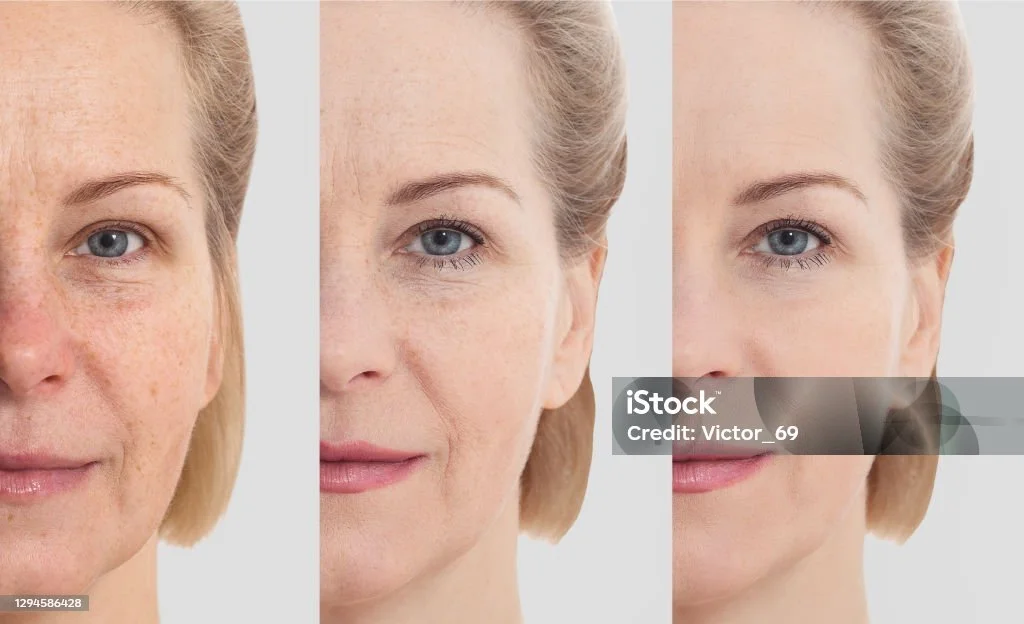
Regenerative Aesthetics
The most sophisticated thing the body can do is heal itself.
Regenerative treatments work by signaling the body’s own repair systems: collagen synthesis, inflammation resolution, cellular renewal, rather than correcting from the outside. Results develop as the biology responds and continue improving as tissue matures.
These treatments are used throughout aesthetic care here: alongside neuromodulators, filler, and threads, and often as the foundation from which other treatments build.
“The most enduring results come from putting the intelligence of the body to work.”

The Collagen Wash.
Biostimulators such as Sculptra or hyperdilute Radiesse work like seeding fertilizer into the skin: the material signals the body to generate new collagen and elastin. The skin responds, rebuilds, and ages in reverse—in the most natural way possible.
Used across the face, neck, and body wherever skin quality, firmness, and radiance are the goal. Results develop gradually as the tissue responds and can last up to two years.

Microneedling creates thousands of controlled micro-injuries that trigger the wound-healing cascade: platelet activation, growth factor release, collagen induction, tissue remodeling. The skin responds by rebuilding.
Exosomes and growth factors applied immediately following microneedling travel through the micro-channels directly into the tissue, delivering cellular signals that modulate inflammation, accelerate healing, and direct the tissue toward collagen synthesis. The combination amplifies and deepens what microneedling alone initiates.
Indicated for skin quality improvement, fine lines, acne scarring, uneven texture, and post-procedure recovery.
Growth factors and exosomes are also used as standalone treatments and following other procedures—including thread lifts and injectables—to support healing, reduce inflammation, and amplify the regenerative response.
Microneedling, Exosomes
& Growth Factors.

PDO Threads.
PDO threads are biostimulatory by mechanism. Whether placed for lifting or for skin quality, the thread creates a controlled foreign body response in the surrounding tissue—initiating a regenerative cascade that lays down collagen along the thread pathway as the body responds.
As the threads dissolve, a collagen framework remains. This framework sustains the result long after the thread itself is gone—the skin supported by collagen it has built in response to the treatment, until natural aging gradually catches up. Smooth threads placed in a precise mesh pattern concentrate this same response on skin quality—improving texture, firmness, and hydration.
LEARN MORE ABOUT PDO THREAD LIFTS →
Hair Restoration.
Microneedling of the scalp stimulates circulation to the follicles and triggers the healing response at the scalp level. Growth factor serums delivered through the micro-channels signal follicle reactivation and support the hair growth cycle. Red light therapy reduces scalp inflammation and amplifies the regenerative signal.
Effective for hair thinning, alopecia, and anywhere follicle stimulation is the goal: scalp, hairline, brows, and beard. A series of treatments produces the most meaningful results.
Platelet-Rich Fibrin (PRF).
PRF is derived from the patient’s own blood, concentrated to yield a dense preparation of growth factors, platelets, cytokines, and fibrin: the same constituents the body uses to repair tissue, stimulate collagen, and resolve inflammation. Reintroduced into the treatment area, it initiates a sustained regenerative response.
PRF is an evolution of PRP. Growth factor concentration is higher, release is slower and more sustained over days, and clinical results are correspondingly more significant. It is used as a volumizing treatment, a skin quality treatment, and in combination with microneedling to deepen the regenerative response.
How these work together.
Regenerative treatments compound.
Sequencing is always considered as part of the broader treatment plan.
Frequently Asked Questions
-
A regenerative signal—biological, mechanical, or photonic—initiates the body’s repair cascade. Platelets activate. Growth factors are released. Fibroblasts are recruited and begin producing collagen and elastin. Inflammation is modulated and resolved. Tissue remodels over weeks and months. The result is skin that is biologically healthier—not corrected on the surface.
-
Both concentrate growth factors and platelets from the patient’s own blood. PRF achieves a higher concentration, incorporates a fibrin matrix that sustains growth factor release over days rather than hours, and produces a more significant and longer-lasting clinical response.
-
Exosomes are nano-sized particles released by cells to communicate with other cells. They carry growth factors, proteins, and biological instructions that signal tissue repair, collagen production, and regeneration. In aesthetic medicine, they are applied to deliver these signals directly into the skin or scalp—amplifying the regenerative response initiated by microneedling or other treatments. The improvements they produce are cumulative and continue developing over time.
-
Fillers like hyaluronic acid add volume immediately. Collagen stimulators—Sculptra, Radiesse—trigger the body to produce its own collagen over months. Used in hyperdilute form as a collagen wash, Radiesse distributes this biostimulatory effect broadly rather than in a targeted location. The approaches address different concerns and are often used together.
-
Three to four sessions spaced four to six weeks apart typically produces meaningful improvement, with results continuing between sessions as collagen matures. Maintenance every six to twelve months sustains the result. Acne scarring and more significant texture concerns may require additional sessions.
-
Topical numbing is applied before treatment. Most patients find it very manageable. Redness and mild swelling for twenty-four to forty-eight hours following treatment is normal and resolves on its own.
-
The mechanism is well established. Specific wavelengths of red and near-infrared light are absorbed by mitochondria, stimulating cellular energy production and triggering anti-inflammatory and regenerative effects. Clinical evidence supports its use for skin quality, inflammation reduction, wound healing, and hair regrowth. Effects are real and cumulative with consistent use.
-
Microneedling of the scalp stimulates circulation to the follicles, triggers the body’s healing response at the scalp level, and creates channels for growth factor delivery. Combined with red light therapy, the protocol addresses both inflammation and the regenerative stimulus needed for follicle reactivation. Most effective for diffuse thinning and early to moderate hair loss. Results require a series of treatments.
-
PRF: results develop over six to eight weeks, typically lasting twelve months or longer. Collagen wash: improvements over two to three months, lasting up to two years. Microneedling: results build over several months, maintained with periodic sessions. PDO threads: lifting threads maintained at eighteen months to two years; smooth threads every six to twelve months. All results continue improving as collagen matures.
-
Yes. Regenerative treatments improve the tissue environment that other treatments work within—affecting integration, longevity, and the amount needed. The treatment plan is always considered as a whole.
-
Most patients are appropriate candidates—whether beginning with skin quality improvement, extending existing aesthetic results, managing hair thinning, or reducing reliance on structural correction over time. The right combination is determined in consultation.